|
Gottfried Wilhelm Leibniz (1646-1716) -- wynalazca
kalkulatora, twórca arytmetyki binarnej, autor projektu arytmetyzacji logiki
i projektu uniwersalnego algorytmicznego języka -- wierzył
niezachwianie, że dzięki postępom techniki obliczeniowej oraz logiki każdy
problem naukowy będzie rozstrzygalny mechanicznie drogą
rachunku. Tej wierze filozof dał wyraz w haśle: calculemus!
Kwestia realności takiego programu i symbiozy ludzi i
maszyn, tj. dopełniania się twórczej intuicji oraz pomysłowości ludzkiego
umysłu z potęgą obliczeniową maszyn -- to wyzwanie filozoficzne,
technologiczne i cywilizacyjne tego wieku.
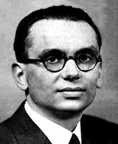
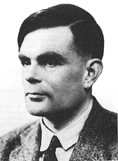
Niezrównanymi w tych kwestiach przewodnikami są: Kurt Gödel (z
lewej) i Alan Turing (z prawej),
ikoną zaś domeny calculemus.org
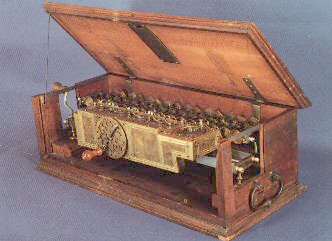
jest otwierający tę stronę obraz kalkulatora Leibniza.


 "Cafe Aleph" - Lectorium -- witryna
będąca tekstową bazą danych na temat światopoglądu informatycznego,
epistemologii, filozofii nauki, filozofii informatyki, filozofii umysłu,
etyki, retoryki, filozofii politycznej etc. "Cafe Aleph" - Lectorium -- witryna
będąca tekstową bazą danych na temat światopoglądu informatycznego,
epistemologii, filozofii nauki, filozofii informatyki, filozofii umysłu,
etyki, retoryki, filozofii politycznej etc.
Polemiki i Rozmówki w "Cafe
Aleph" -- Blog akademicki pod redakcją Witolda Marciszewskiego i
Pawła Stacewicza, -- to forum dyskusyjne dla podejmowanych w "Cafe
Aleph" zagadnień.
Polemics and Talks in "Cafe Aleph"
-- An academic blog edited by Witold Marciszewski and Paweł
Stacewicz, intended as a forum to discuss the issues as listed in
the previous item.]
Na szyldzie kawiarni widnieje  (aleph) - symbol
nieskończonych zbiorów liczb. W tej abstrakcyjnej krainie bywalcy "Cafe
Aleph" znajdują impuls i materiał do refleksji, ile może zdziałać umysł
ludzki zażyły z nieskończonością, a ile zdoła maszyna. Refleksja ta owocuje
światopoglądem informatycznym. (aleph) - symbol
nieskończonych zbiorów liczb. W tej abstrakcyjnej krainie bywalcy "Cafe
Aleph" znajdują impuls i materiał do refleksji, ile może zdziałać umysł
ludzki zażyły z nieskończonością, a ile zdoła maszyna. Refleksja ta owocuje
światopoglądem informatycznym.
[ "Cafe Aleph" - Lectorium --
the website being a text database concerning epistemology, philosophy of
science, philosophy of computer science, ethics, rhetoric, political
philosophy, informational worldview, liberal worldview, etc.
It from bit? Some links to help our understanding
of the universe's computational power.
Witold Marciszewski, 2015 *
This sketch hints at a crucial issue of informational worldview as
the main subject of Cafe Aleph discussions.
"Our Pub"
Library and the academic blog "Our Pub". Jointly, they form
integrated sites providing a forum for questions belonging to the
intersection of philosophy with logic and compuer science, and the
intersection of computationally oriented philosophy with political and
economic issues, esp. those concerning Europe.
Lectorium
dydaktyczne. Tworzony sukcesywnie w latach 1999-2012 warsztat
wykładowcy (sylabusy, wykłady, zadania, odesłania do literatury), głównie z
zakresu logiki, metodologii nauk, w szczególności społecznych, oraz
filozofii umysłu i informatyki [A lecturer's workshop,
being successively created in 1999-2012, comprising logic, methodology of
sciences, esp. social sciences, philosophy of mind and of computer science:
syllabuses, lectures, exercises, links and references.]
Alfred Tarski, "Wprowadzenie do logiki i do metodologii nauk
dedukcyjnych", Warszawa 1994. Klasyczna pozycja podręcznikowej
literatury logicznej w przekładzie (Moniki Sujczyńskiej) z angielskiego
oryginału z roku 1994. Aktualnie upowszechniana w formacie elektronicznym
wraz z aneksem od redaktora wydania polskiego (Witold Marciszewski)
poświęconym logice predykatów (dział nie uwzględniony w ujęciu Tarskiego).
[A classical textbook on logic, Polish printed
edition 1994, translated into Polish by Monika Sujczyńska from the original
"Introduction to Logic and to the Methodology of the Deductive Sciences";
with the Anex by the Editor of Polish version (Witold Marciszewski).]
STRONY ARCHIWALNE [ARCHIVE PAGES]
Wybrane publikacje Witolda
Marciszewskiego w formacie elektronicznym.
Mathesis Universalis.
On Logic, Mind and Complex Systems: Web Guide and Dialog
Forum.  Appeared in 1996-2002.
Serwis Edytorski czasopisma Studies in Logic, Grammar and
Rhetoric ukazującego się pod auspicjami Polskiego Towarzystwa
Logiki i Filozofii Nauki. [Editorial messages concerning the mentioned
journal which appears under the auspices of Polish Association for Logic and Philosophy
of Science. Free access to the
Studies on line.
Konferencje (wybór najważniejszych) od roku 2002
organizowane lub współorganizowane przez właściciela tej domeny.
[Conferences organized with a considerable contribution of this domain's
owner]. Appeared in 1996-2002.
Serwis Edytorski czasopisma Studies in Logic, Grammar and
Rhetoric ukazującego się pod auspicjami Polskiego Towarzystwa
Logiki i Filozofii Nauki. [Editorial messages concerning the mentioned
journal which appears under the auspices of Polish Association for Logic and Philosophy
of Science. Free access to the
Studies on line.
Konferencje (wybór najważniejszych) od roku 2002
organizowane lub współorganizowane przez właściciela tej domeny.
[Conferences organized with a considerable contribution of this domain's
owner].
2012: IX Polski Zjazd Filozoficzny.
Strona sieciowa Zjazdu.
LogBank. Some facts
concerning logic collected in the period 1995-1998.
Witold Marciszewski: "Szkice do
współczesnej metodologii nauk społecznych".
Książka internetowa. Wyd. Fundacja na rzecz Informatyki, Logiki i
Matematyki, Warszawa 2002. [Essays in the Modern
Methodology of the Social Sciences].
Forum Logiki, Informatyki i Filozofii
Nauki. [Forum for Logic, Informatics and
Philosophy of Science].
Komitet Nauk Filozoficznych PAN
(kadencja 2000-2003). [Philosophical Committee,
Polish Academy of Sciences]. Zawiera odsyłacze do
serwisów dotyczących filozofii w Polsce.
Fundacja na rzecz
Informatyki, Logiki i Matematyki.
|
The call CALCULEMUS (let's compute) sums up Gottfried
Wilhelm Leibniz's (1646-1716) approach to arguments. It encourages those
engaged in a dispute to turn arguments into computing. In this enterprise,
they may enjoy assistance of a reasoning machine. Leibniz believed that such
a machine can be constructed on the basis of a calculating machine, because
- anticipating modern logic - he identified reasoning with computing.
The picture above presents
Leibniz's mechanical calculator which was capable (unlike the earlier
machines of Schickard and of Pascal) also of multiplying and dividing;
nowadays it is kept in Leibniz's House in Hannover. Leibniz was very proud
of his invention, and once he thought of commemorating it with a medal
bearing the motto Superior to Man. Though much exaggerated, such a
motto might have expressed the idea that, when starting from such a simple
prototype, one could gradually attain the level of most advanced reasonings
to be carried out by machines (as presently hoped by strong AI). It was also
Leibniz who invented binary arithmetic, and so much praised that achievement
that designed a medal with the following inscriptions: the model of
creation discovered by G.W.L, and one is enough for deriving
everything from nothing.
By choosing this picture as the logo and calculemus
as the motto of this domain, one endorses Leibniz's insight as to the power
of computing.
|
Within this domain there is also a store of documents (English, German, Polish) Aera Informatica concerning
information society. This section contains the journal (Polish) Kurier Polityczny which appeared in
1996-1997 to support the ideas of the party "Unia Wolnosci".
|
|
To the top of this page
|